How to Explain Employment Gaps on Your Resume (Without Sounding Apologetic)
For years, the "Employment Gap" was the ultimate taboo. A period of unemployment on a resume—whether it was six months or two years—was viewed by recruiters as a scarlet letter. It signaled that you were "unwanted," "lazy," or that your skills had atrophied. Candidates were taught to hide these gaps with formatting tricks or vague lies.
But the world has changed. The post-pandemic era, marked by mass layoffs, the Great Resignation, and a focus on mental health, has normalized the non-linear career path. LinkedIn even introduced a dedicated "Career Break" feature, officially validating that life happens outside of work.
Despite this shift, the anxiety remains. When an interviewer points to that blank space on your timeline and asks, "So, what were you doing between 2022 and 2023?", many candidates panic. They stammer, apologize, or over-explain.
The secret to handling a gap is confidence. A gap is only a red flag if you treat it like one. If you own your story, frame it positively, and pivot back to your value, a gap can actually demonstrate resilience and intentionality.
This guide will teach you how to address employment gaps on your resume and in the interview, covering scenarios ranging from layoffs and health issues to caregiving and travel.
The Psychology: What Recruiters Actually Fear
Recruiters don't care that you took a break. They care about why and what it did to you. Their hidden fears are: 1. Obsolescence: Have you forgotten how to do the job? 2. Unemployability: Did other companies reject you during this time? 3. Flight Risk: Will you leave again abruptly?
Your explanation must address these fears directly.
Strategy 1: The Resume (Formatting the Gap)
Do not try to hide a significant gap (6+ months) by using only "Years" instead of "Months" (e.g., "2020 - 2021"). Background checks will reveal the specific dates, and you will look dishonest.
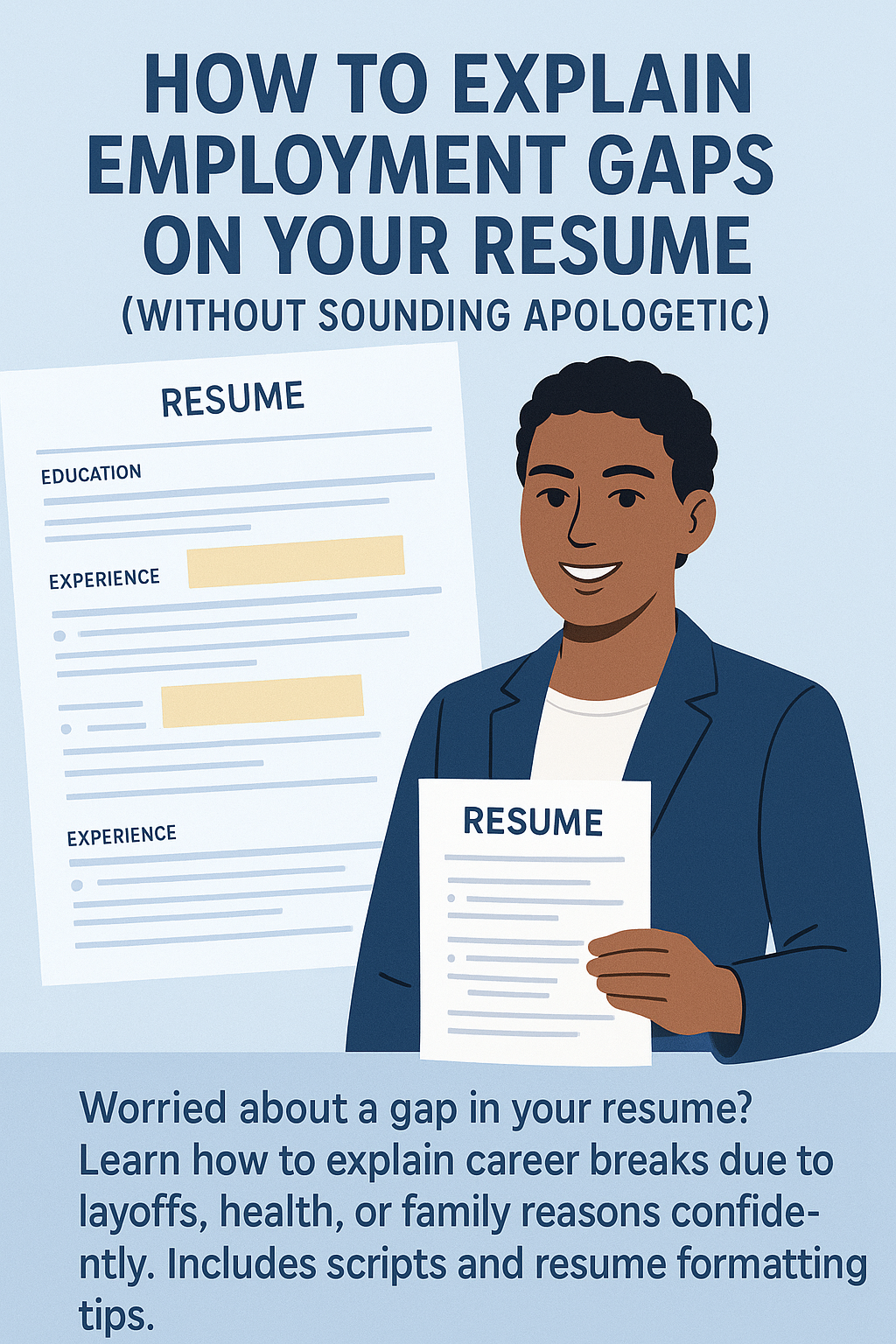
Instead, label the gap. Treat it like a job entry. This takes control of the narrative before they even ask.
Example 1: The Layoff/Job Search
Career Break | Professional Development (Jan 2023 – Present) * Actively pursuing certification in [Skill Name] via [Course Provider]. * Engaging in freelance consulting projects for [Industry] clients.
Example 2: The Caregiving Break
Career Break | Full-Time Caregiver (June 2021 – Dec 2022) * Managed full-time care for a family member. * Maintained industry knowledge through [Newsletters/Podcasts]. * Status: Fully ready to return to the workforce.
Example 3: The Sabbatical/Travel
Planned Sabbatical (Jan 2019 – Dec 2019) * Traveled to 12 countries to gain cross-cultural perspective. * Improved adaptability and budget management skills.
Strategy 2: The Interview (The Scripts)
When the question comes, keep your answer Short, Honest, and Forward-Looking. Use the "Sandwich Method": Brief context -> The positive aspect -> Pivot to the future.
Scenario A: The Layoff (It wasn't your fault)
Layoffs are common. Remove the shame.
"My previous role was eliminated during a company-wide restructuring that affected 20% of the workforce. Since then, I’ve been deliberate about finding a role that fits my long-term goals, rather than jumping at the first option. In the meantime, I’ve kept my skills sharp by [mention a course or project]."
Scenario B: Health/Medical Issues (Keep it private)
You do not need to disclose your specific diagnosis.
"I took some time off to address a personal health matter. That issue is now fully resolved, and I have a clean bill of health. I’m recharged and eager to get back to [specific job function]."
Scenario C: Caregiving (Maternity/Paternity/Elderly Parents)
This is admirable, not shameful.
"I took a planned career break to focus on raising my young children/caring for an elderly parent. It was the right decision for my family at the time. Now that my children are in school/support systems are in place, I am fully ready to return to full-time work and bring my focus back to my career."
Scenario D: "I Just Burned Out" (The tricky one)
Be careful with the word "burnout," as it implies you can't handle stress. Frame it as "Recharging."
"After 10 years of non-stop work in high-pressure roles, I decided to take a planned sabbatical to recharge and gain perspective. I spent the time traveling and [hobby]. It was incredibly refreshing, and I’m now coming back with renewed energy and a clear focus on [Industry]."
Scenario E: The Failed Startup/Freelancing
If you tried to start a business and it failed, frame it as an MBA in the real world.
"I took a year to pursue an entrepreneurial venture. While we didn't achieve the scale we hoped for, I learned invaluable lessons about P&L management and customer acquisition that I couldn't have learned in a corporate role. I’m now looking to apply that ownership mindset within a structured team."
The "Bridge" Project
The best way to silence doubts about a gap is to show you were still active. Even if you were unemployed, find a way to show professional activity: * "I consulted..." (Even if it was unpaid advice for a friend's business). * "I upskilled..." (List the books you read or courses you took). * "I volunteered..." (Community leadership counts as leadership).
Conclusion: Own Your Timeline
Your career is a marathon, not a sprint. Almost everyone stumbles or takes a water break. The candidates who get rejected are the ones who try to cover up the gap with lies or defensive body language. The candidates who get hired are the ones who say, "Yes, I took time off. Here is what I learned, and here is why I am ready to crush this job today."
If you are returning to the workforce after a break, make sure your resume highlights your most current skills. Use the JobPe Resume Builder to structure your "Career Break" section professionally.
For more resources to help you navigate your return to work, https://jobpe.com.

