
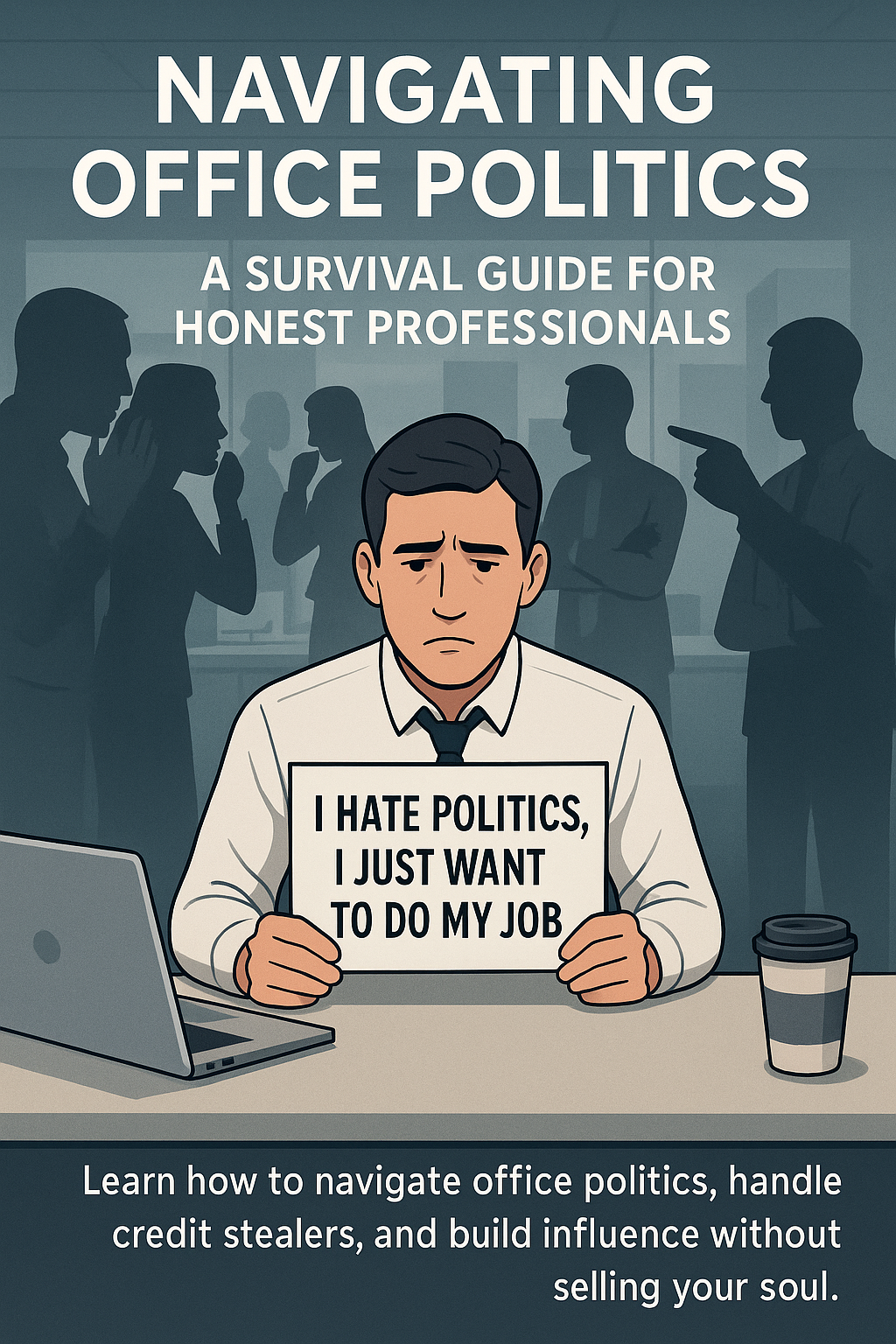
Navigating Office Politics: A Survival Guide for Honest Professionals
If you ask ten employees what they hate most about their jobs, seven of them will say: "The Politics."
Most honest, hard-working professionals view office politics as a dirty game. They adopt the "Ostrich Strategy": I will keep my head down, do my work perfectly, and ignore the drama. My results will speak for themselves.
This is a noble sentiment. It is also a dangerous career strategy.
In the real world, results rarely speak for themselves. They need a translator. Decisions about your promotion, your salary, and your project assignments are rarely made based on a spreadsheet alone; they are made by human beings with egos, biases, and agendas.
Refusing to engage in office politics doesn't mean you aren't playing the game; it just means you are playing it with your eyes closed.
"Office Politics" doesn't have to mean backstabbing, gossiping, or sucking up. At its core, politics is simply relationship management and influence. It is the art of getting things done in an environment where resources are limited and opinions differ.
This guide is for the "nice" employee. It will teach you how to protect yourself from bad actors, how to make sure your work gets recognized, and how to win the game without selling your soul.
The Three Archetypes You Will Meet
To survive, you first need to identify the players on the board.
1. The Credit Stealer
- The Behavior: You share an idea in a casual chat. Two days later, they present it in a meeting as their own. Or, they say "We did this" when you did the work.
- The Defense: Never share raw ideas with them privately. Share ideas in emails (paper trail) or public meetings. When they try to claim credit, use the "Correction Sandwich":
- "Thanks for bringing that up, Rahul. As I mentioned in my analysis last week [The Correction], I think the key to executing this is..."
2. The Gatekeeper
- The Behavior: They hoard information. They control access to the boss or a specific resource. They love saying "No" because it makes them feel powerful.
- The Defense: Do not fight them; charm them. Gatekeepers usually feel underappreciated. Publicly acknowledging their help ("I couldn't have done this without Sarah's help with the data") often unlocks the gate.
3. The Gossip
- The Behavior: They trade secrets for social currency. They want to bond with you by complaining about others.
- The Defense: be boring. When they try to vent to you about a colleague, give a neutral, non-committal response: "Oh really? I haven't noticed that." If you give them nothing, they will move on to a more interesting target.
The 4 Rules of Ethical Politics
You don't have to be a villain to win. Follow these rules to build "Clean Influence."
Rule 1: Build Alliances Before You Need Them
Don't wait until you are in trouble to make friends. * The Strategy: Identify the "Influencers"—not necessarily the bosses, but the people everyone listens to. Have coffee with them. Help them with small tasks. * Why: When you need a favor or when someone attacks your reputation, these allies will defend you when you aren't in the room.
Rule 2: Market Your Wins (The "Humble Brag")
If you do great work in the dark, it doesn't count. * The Strategy: Send a "Weekly Recap" email to your manager. * Subject: Update on Project X & Key Wins * Body: "Just wanted to keep you in the loop. This week we shipped X, which solved Y problem." * Why: This isn't bragging; it is reporting. It gives your boss ammunition to defend your performance to their boss.
Rule 3: Never Complain Without a Solution
Complaining makes you look weak. Solving makes you look powerful. * Bad Politics: "The new software is terrible; it crashes constantly." (You look like a whiner). * Good Politics: "The new software is slowing down the team. I’ve researched two alternatives that cost the same but offer better stability. Should I run a pilot?" (You look like a leader).
Rule 4: Understand the "Currency" of Your Boss
Everyone wants something different. * Does your boss care about Innovation? Pitch them new ideas. * Does your boss care about Safety/Risk? Show them how your plan prevents errors. * Does your boss care about Looking Good to the CEO? Give them wins they can present upwards. * Align your work with their ego.
The Nuclear Option: Document Everything
Sometimes, you encounter a truly toxic political operator who is trying to sabotage you. In this case, your best friend is the Paper Trail.
- CYA (Cover Your Assets): After a verbal conversation where a risky decision is made, send an email:
- "Hi [Name], just to recap our discussion: You asked me to bypass the standard quality check to meet the deadline. I will proceed as directed."
- If things blow up later, you have proof you were following orders.
Conclusion: It’s Just Human Nature
Office politics is unavoidable because it is simply human nature at scale. It is about trust, communication, and perception.
You can choose to be a victim of politics, or you can choose to be a master of it. By building genuine relationships, protecting your credit, and aligning with the company's goals, you can rise to the top while keeping your integrity intact.
To find organizations that prioritize transparency over toxicity, research company reviews on JobPe Companies.
For more strategies on managing your career growth, https://jobpe.com.

