
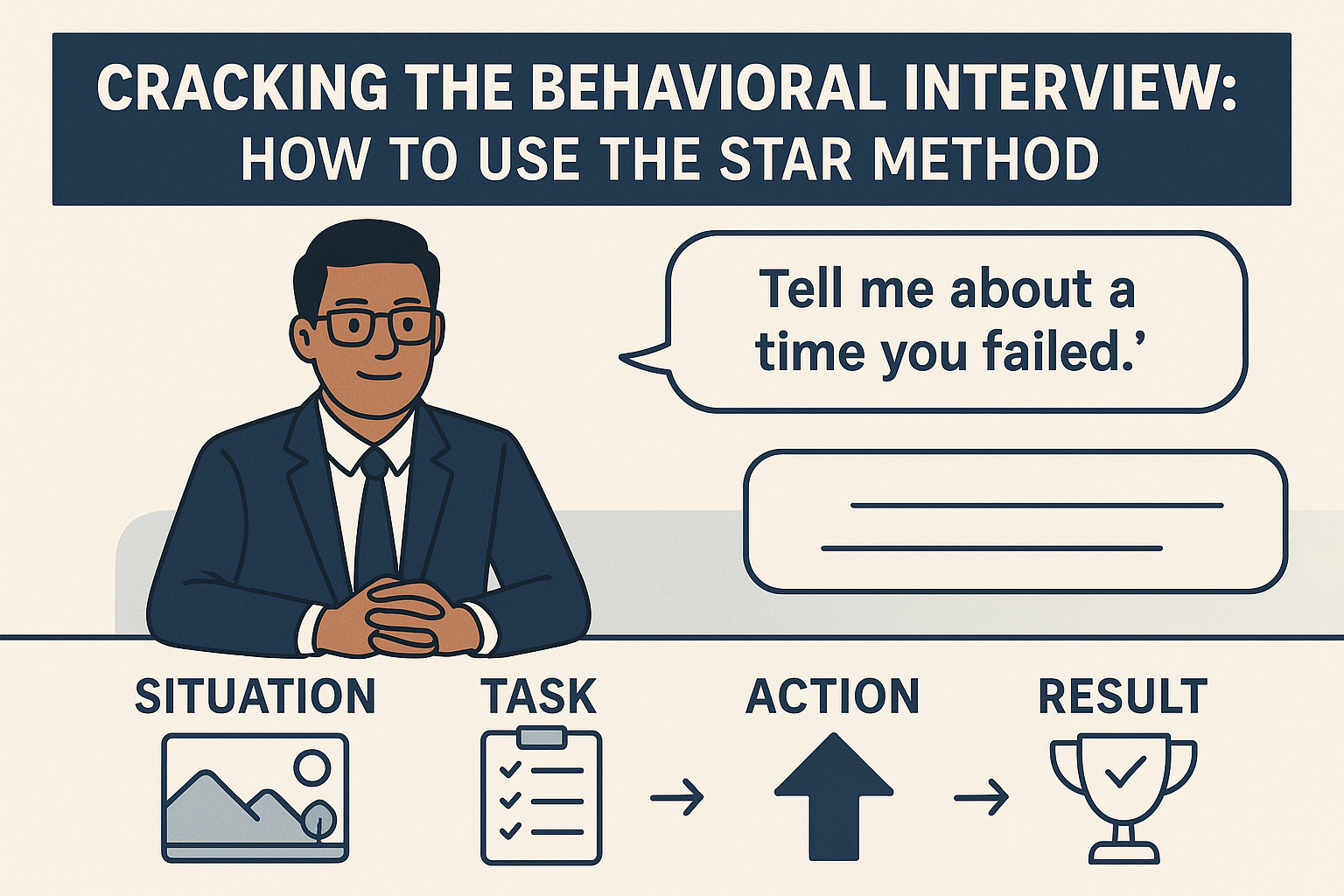
Cracking the Behavioral Interview: How to Use the STAR Method to Ace Tough Questions
You are in the middle of an interview. The technical questions are over. You are feeling good. Then, the interviewer leans back and asks:
"Tell me about a time you had a conflict with a coworker and how you resolved it."
Your mind goes blank. You scramble for an example. You start rambling about a minor argument you had three years ago, get lost in the details, and end the story awkwardly without really answering the question.
This is a Behavioral Interview Question. Unlike technical questions (which test what you know), behavioral questions test how you think. They are based on the premise that past behavior is the best predictor of future performance.
Recruiters use them to test for soft skills: leadership, conflict resolution, adaptability, and resilience. If you answer these vaguely ("I’m a good problem solver"), you fail. You need a structured, evidence-based story.
Enter the STAR Method.
The STAR method is a universally recognized formula for structuring interview answers. It turns a rambling story into a concise, compelling case study of your success. This guide will teach you how to master it.
The Formula: S.T.A.R.
Whenever you hear a question starting with "Tell me about a time..." or "Give me an example of...", immediately deploy this structure:
1. Situation (S)
Set the scene. Give the necessary context, but keep it brief (1-2 sentences). * Don't say: "So, it was 2022, and I was working at this company, and the coffee machine was broken..." * Do say: "In my previous role as a Marketing Associate, our team was facing a sudden drop in website traffic due to a Google algorithm update."
2. Task (T)
Describe the challenge or the goal. What were you responsible for? * Do say: "My task was to identify the cause of the drop and recover our traffic numbers within 30 days."
3. Action (A) – The Most Important Part
Explain exactly what YOU did. * The Trap: Do not say "We." ("We had a meeting," "We fixed it.") The interviewer isn't hiring your team; they are hiring you. * Do say: "I took the initiative to audit our top 50 blog posts. I identified that our keywords were outdated. I then created a content refresh plan and coordinated with the design team to update the visuals."
4. Result (R)
Share the outcome. End with a bang. Use numbers if possible. * Do say: "As a result, we not only recovered the traffic but increased it by 15% compared to the previous quarter. My manager later adopted this audit process for all future campaigns."
Putting it to Practice: The "Failure" Question
Question: "Tell me about a time you made a mistake."
The STAR Answer:
- Situation: "When I first joined TechCorp as a Junior Dev, I was eager to prove myself."
- Task: "I was tasked with pushing a minor code update to the production server on a Friday evening."
- Action: "In my rush, I skipped the final peer review step. I deployed the code, and it ended up crashing the checkout page for 20 minutes. I immediately alerted my manager, rolled back the update to the previous version, and stayed late to identify the bug."
- Result: "The site was restored quickly. More importantly, I learned the value of protocol over speed. I volunteered to write a new 'Pre-Deployment Checklist' for the team, and I have never skipped a peer review since."
Top 5 Behavioral Questions to Prepare
You cannot predict every question, but you can prepare 5 "Core Stories" that can be adapted to fit almost anything.
1. The Conflict Story
- Question: "Tell me about a time you disagreed with a boss/colleague."
- Focus: Show professional maturity. Do not badmouth the other person. Focus on the compromise and the shared goal.
2. The Leadership Story
- Question: "Tell me about a time you took initiative."
- Focus: It doesn't have to be a formal management role. It can be organizing a team lunch or fixing a broken process.
3. The Pressure Story
- Question: "Tell me about a time you had to meet a tight deadline."
- Focus: Show your prioritization skills and ability to stay calm.
4. The Failure Story
- Question: "Tell me about a time you failed."
- Focus: Do not say "I have never failed." (That is a lie). Pick a real mistake, but focus heavily on the Lesson Learned.
5. The Adaptability Story
- Question: "Tell me about a time a project changed direction at the last minute."
- Focus: Show that you are flexible and solution-oriented, not someone who complains when plans change.
Tips for STAR Mastery
- Keep it "You" Focused: Use "I" statements in the Action section.
- Quantify Results: "Improved efficiency" is vague. "Saved 10 hours a week" is powerful.
- Be Concise: The whole story should take 90 seconds to 2 minutes maximum.
- Don't Fake It: Skilled interviewers ask follow-up questions ("What exactly did you say in that email?"). If you made up the story, you will crumble.
Conclusion: Storytelling is a Skill
The candidate with the best experience doesn't always get the job. The candidate who tells the best story about their experience gets the job.
Prepare your stories. Write them down in STAR format. Rehearse them until they flow naturally. When you can articulate your value clearly, you stop hoping for the job and start convincing them they need you.
To practice these scenarios with real-time feedback, try the JobPe Mock Interview Tool.
For more interview hacks, https://jobpe.com.

