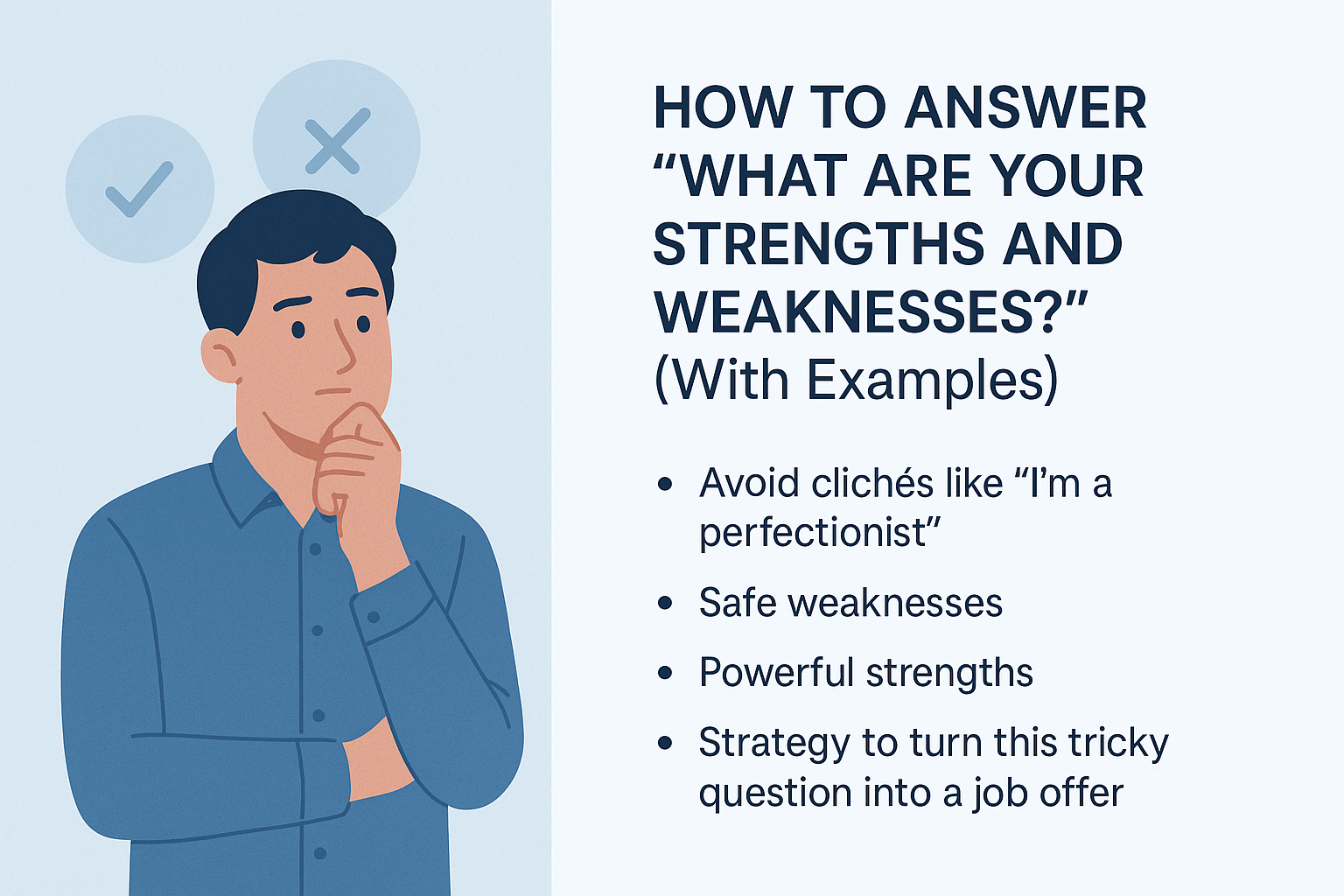
How to Answer "What Are Your Strengths and Weaknesses?" (With Examples)
It is the classic interview cliché. You are sitting in the HR round, and the interviewer looks at their notepad and asks:
"What are your greatest strengths and weaknesses?"
It seems like a simple question, but it is actually a psychological trap. * If you are too honest about your weaknesses ("I'm lazy in the mornings"), you disqualify yourself. * If you are too humble about your strengths ("I'm okay at coding"), you look unconfident. * If you use the fake "humble-brag" weakness ("I work too hard" or "I am a perfectionist"), the interviewer will roll their eyes because they have heard it 500 times today.
Recruiters ask this question to test two things: Self-Awareness and Honesty. They want to know if you can honestly assess your own skills and if you are actively working to improve them.
This guide provides a curated list of "Safe Weaknesses" and "Power Strengths," along with the exact scripts to answer this question without sabotaging your chances.
Part 1: How to Talk About Your Weaknesses (The Strategy)
The "Weakness" part is where most candidates fail. The secret is to pick a real weakness that is fixable and not fatal to the job.
The Formula: 1. State the Weakness: Be specific, not vague. 2. The Context: When does it happen? 3. The Fix (Crucial): What are you actively doing to solve it?
Top 3 "Safe" Weaknesses to Use
1. Public Speaking / Presentation Skills
- Why it works: It’s a common fear that doesn't affect your ability to code, write, or analyze data.
- Script: "I’ve historically struggled with public speaking. I tend to get nervous when presenting to large groups, which sometimes makes me rush through my slides. To fix this, I’ve recently joined a local Toastmasters club to practice, and I volunteer to lead our internal team stand-ups to get more comfortable with an audience."
2. Delegating Tasks (For Senior/Lead Roles)
- Why it works: It shows you are a high performer who cares about quality, but acknowledges you need to trust others more.
- Script: "I sometimes struggle with delegation. I tend to want to do everything myself to ensure it's perfect, which can lead to a bottleneck. I’m actively working on this by using project management tools like Asana to assign tasks and trusting my team’s ownership, stepping in only for final review."
3. Being Too Critical of Yourself
- Why it works: It shows high standards without the cliché "perfectionist" label.
- Script: "I can be overly critical of my own work. I sometimes spend too much time tweaking a project after it’s already 'good enough,' which can slow me down. I’ve been practicing setting strict time limits for revisions so I can ship faster and iterate based on feedback rather than trying to get it 100% right on the first try."
What NOT to Say (The "Fatal" Weaknesses)
- "I have no weaknesses." (Arrogant and untrue).
- "I struggle to wake up on time." (Unprofessional).
- "I don't work well with people." (Fatal for almost any job).
- "I work too hard." (The fake answer. Don't use it).
Part 2: How to Talk About Your Strengths (The Strategy)
The "Strength" part is your chance to align your skills with the job description. Do not just pick a random adjective; pick a strength that solves their problem.
The Formula: 1. State the Strength: Use a strong adjective. 2. The Evidence: Give a mini-example (STAR method). 3. The Application: How it helps this company.
Top 3 "Power" Strengths to Use
1. Adaptability / Learning Agility
- Best for: Startups and Tech roles.
- Script: "My greatest strength is my adaptability. In my last role, our tech stack changed from Java to Python overnight. While others panicked, I spent the weekend taking a crash course and was writing production-ready code by Monday. I know things move fast here, and I pride myself on being able to pivot quickly."
2. Problem Solving under Pressure
- Best for: Customer Support, Operations, and Sales.
- Script: "I thrive in high-pressure situations. When a server outage hit my previous company during Black Friday sales, I was able to remain calm, coordinate the engineering team, and communicate updates to stakeholders. I don't get flustered easily; I focus on the solution."
3. Empathy / Emotional Intelligence
- Best for: HR, Management, and UX Design.
- Script: "My strength is empathy. I have a knack for reading the room and understanding what a client or colleague is really feeling, not just what they are saying. This has helped me de-escalate conflicts and build long-term relationships with difficult clients."
The "Combo" Answer (Putting it Together)
If asked for both in one breath, start with the weakness (get the bad news out of the way) and end with the strength (finish on a high note).
Interviewer: "What are your strengths and weaknesses?"
Candidate: "Well, starting with my weakness, I can sometimes be a bit direct in my feedback. I value efficiency, so I used to skip the 'small talk' and jump straight to the critique, which sometimes hurt feelings. I’ve been working on this by using the 'Sandwich Method' to deliver feedback more constructively.
On the flip side, my greatest strength is my ability to execute complex projects. Once I have a goal, I am incredibly organized in breaking it down and driving it to completion. In my last role, this focus allowed me to deliver the Q3 project two weeks ahead of schedule."
Conclusion: Be Real, But Strategic
The "Strengths and Weaknesses" question is not a confession booth. It is a strategic exercise.
Your goal is to show the interviewer that you are a self-aware professional who knows what they bring to the table and is mature enough to work on their gaps.
Prepare your list. Choose one "Safe Weakness" and one "Power Strength" relevant to the job you want. Write them down.
To test if your answers sound natural, practice with the JobPe Mock Interview Tool before your big day.

